Welcome

This is a blog about the pursuits of Naturalist Alan Russo to incorporate all things Natural, especially Plants, into his daily life. Living close to Nature has always been a passion of mine and I try, with natures help, to live a Healthy lifestyle for myself and for the Earth.

Sunday, April 21, 2013

Finally

  Well, I finally did it! After all these years of contemplation and putting it off, I finally took the plunge and it felt good to just let go and do it!
  I have had a long history with the Poke Plant and have had many experiences involving all parts of the plant from the Roots to the Berries. From using the root medicinally, to dying wood art with the Berries and swallowing the Berries whole. But in all this time, I had never eaten the plant itself, probably the most famous part.
  For years I have known that "Poke Salet" was a traditional Springtime favorite of Southerners and after moving to the south I have spoken to many "old timers" about their experiences with poke. Yet even after living here for seven years, I still hadn't tried it.
  Sometimes knowledge can hold you back. I have always believed that traditional knowledge was more important than scientific knowledge. What I mean is, if a culture has been using an herb successfully for thousands of years, and modern science says the plant is dangerous, I would always lean toward the traditional knowledge. On the other hand, being a science lover, I would also take the modern knowledge as part of the equation and weigh in after careful study and thought. And though I wasn't afraid of Poke, after all I had learned and experienced over the years, I thought there were plenty of other Wild Edibles to forage on and Poke was not something I HAD to have.
  One real tipping point for me, among others, was a paper I had read about Poke. I used to teach a two day Wild Edible and Medicinal plant segment for a Natural Medicines class at South Hampton College when I lived in NY. I got to the school early one day and while waiting in the Professors  office, I picked out an interesting book from her great library, and started to read about some Medicinal plants. When I got to the section on Poke, the author quoted some studies of the effects of Poke on the human body. All were negative, but the one that stood out for me was the study showing that Poke actually deformed white blood cells and had a very negative effect on the immune system. The authors recommendation was to never even touch the plant, as even handling the mature plant showed negative effects on white blood cells and white blood cell count.
  Now, on the other side of the coin, one day, while taking a group of 5th graders on a hike to do a Field to Forest Program, I stopped to show the kids the Poke or "Ink" berries and how you can use them to paint your skin. I cautioned the kids never to put the Berries in their mouth as they were very toxic. The schools would often send a chaperone  with each group to help supervise the kids. This day, the Grandmother of one of the students was with us. She later pulled me aside to tell me that when she was younger, her Grandfather and Father would take Poke Berries and place them in Brandy or Vodka and they would drink small amounts through out the winter to help them stay healthy and to help with the pains of old age. I questioned her memory, as I had always learned that the Berries were very toxic, and she assured me that this was the same plant.
  Now you can see why I was being cautious about Poke, these were only two of the many contradictory learning experiences with this intriguing plant.
  Fast forward to the present. I decide to give Poke the chance it deserves in my repertoire of Wild Edible Plants. So, using what I had learned over all these years, I just went for it. I picked the poke at the very young stage, just as it was emerging from a long winters sleep and still not fully unfurled. This is the safest time to use poke and I have learned that once the base of the plant and the petioles and leaf veins start to turn red, they are getting toxic and should not be picked.


Young Poke plants before turning Red at the base

  Poke should never be eaten raw! Where people get into trouble is misreading "Poke Salet" as "Poke Salad" and get sick when they make a salad of raw Poke leaves. Always cook Poke in two changes of water before eating. It is best to have a second pot of boiling water ready so you can add boiling water to the hot Poke after straining off the first boiling water. It is not a good idea to add cold water to the pot to start the boiling from scratch again.
  This may seem like a lot of trouble to go through to eat some plant, but with the abundance of Poke around this time of year it is no trouble at all for a bunch of good healthy meals.

Ready to Eat!

Wednesday, April 17, 2013

Scrambled Eggs and Nettles


It's that time of year again, where my Nettle patch is exploding! No food in the fridge for lunch, what to do? Nettles of course, simple and fast.
  I heat up the frying pan and add oil, than add the Nettles and keep them moving. To speed up the process, I add about a half cup of water and cover quickly to steam the Nettles till they wilt, than remove the cover and let the water evaporate to make sure the Nettles are dry when I add the eggs ( I hate watery eggs). Scramble as many eggs as you like and add them to the Nettles and keep them moving. Viola! A supper healthy lunch.
Peace
PS Check the archives for other great stuff to do with Nettles

Monday, April 15, 2013

Spring Salad


  I know, it's been awhile, a long while, and I apologize. Life often gets in the way of Living! I had a tough winter, but now that the Spring is here, things are getting better, and I have had some time to spend with the plants, but of course, not as much time as I would like too.
 I did make my first official wild Spring salad the other day. I say official because I have been nibbling here and there as I find patches of certain plants but have not had much time to put it all together into a salad. We had a cold Winter this year that lasted through the first week of April than over night went right into Summer. Of course I am referring to the Weather not the Astronomical Sun/Earth alignment. It literally went from the 20s and 40s to the mid 80s in two days! So, the early abundance we had last year took awhile to happen, but it is finally here.
 Today's salad consisted of Chickweed, Mustard Flowers, Violet Leaves and Flowers, Dandelion Leaves and Flowers, Cleavers, Thistle Leaves, Tulip Flowers, Queen Annes lace Leaves, Redbud Flowers and probably a few bugs of various kinds! I topped it with homemade apple vinegar with Field Garlic as a seasoning.
  A nice way to start off the season.
Peace

Thursday, October 18, 2012

Nettles (again!)

  It's that time of year again, when my Nettle patch explodes with growth, after a long hot Summer. Nettles die back in the Summer after flowering, and stay pretty much dried up till the days start getting shorter and cooler.


I was trying to think of something different to do with the Nettles and I kept thinking SOUP. I have made a classic Nettles potato soup before ( http://ethnobotanist128.blogspot.com/2011/04/nettlespotato-soup.html ) but I wanted to try something different. The only other thing ready in my garden is Sweet Potatoes, so I wondered how it would taste substituting Sweet for regular Potatoes in the soup. I dug up a bunch of Sweet potatoes and cut just the succulent tops of the Nettles and headed for the kitchen.
 I cleaned and diced the Sweet Potatoes, covered them with water, and cooked till tender. I added the Nettles and cooked for another 8-10 min. I added just a little salt and pureed the mixture till it was a smooth consistency. Now was the time to taste.


  Wow, it was so good! Way better than with the Regular potatoes. The unique taste of the Nettles and the sweetness of the potatoes was a great combo. I ate two bowls!
 Than I started to think what else can I do with this soup. The next day I decide to add some Curry powder and a touch of Organic Butter to a bowl of soup and it was amazing! Than for lunch the next day I added some leftover cooked Black Beans for some extra body and the soup was delicious and filling at the same time. Any one of these combos would be even better with a little Organic heavy cream in them which would make it a nice rich cream soup guaranteed to fill you up. You could also start the soup with Chicken Stock instead of water for another flavor all together.
 Nettles are high in protein and  loaded with vitamins and minerals. It is one of the most nutritious plants on the planet, not to mention all the Medicinal value each part of the plant has to offer. So, find a safe patch of Nettle and bring some home an give them a special place in your garden so you can have them handy.
Peace

Wednesday, October 10, 2012

What to do with my Dinosaurs?


  Every year I try to plant something new/different around my chicken coop. This serves a couple of practical purposes. One, I have a ready made fence for vines to clime on, and two, the chickens have ample shade in the heat of the summer which thy really appreciate. Also I get to plant some cool stuff I don't have room in my gardens for. I've had Luffa, bottleneck gourds, mango melons and a permanent section for Passion Flower Vines. This year I planted "Dinosaur gourds", also known as "Caveman's Club", they are a very unique looking gourd which I have always wanted to grow.
 I have tried before, but for some reason they didn't grow. But this year they really went crazy, so much so I have had to trim them back several times as they were starting to take over and smothering my Honeysuckle Vines, ( see:  http://ethnobotanist128.blogspot.com/2011/05/japanese-honeysuckle.html) which also have a permanent spot on the fence.
 As cool as these Gourds are I have no idea what to do with them! There is not much info on them, but as far as I can tell they are not Edible. I have seen a site where someone made a Dinosaur looking sculpture out of one but that's about it. I also e-mailed the head of a Gourd Society to get some more info on them and the women wrote back that she never heard of them!
 So, if anyone has any definitive info on these unique Gourds, please feel free to e-mail me or write some comments to help us get some info.
Peace

Thursday, September 27, 2012

Wonderberry

 I get a seed catalog called "an Ethnobotanical catalog of seeds" and every year I drool over all the plants I wish I could grow in my garden. Every year I try to buy some seeds of Wild Edible or Medicinal Plants that I have not heard of or seen before. A couple of years ago I bought some seeds for a plant called Wonderberry. The description spoke of Edible fruits and prolific growth and as it is a plant that would grow in my area I figured I'd give it a try. The problem with this catalog is the lack of photos, it does have some line drawings of some plants but for the most part there is just a description. So, Spring came around and I tossed some seeds in a newly tilled garden just to see what would happen.
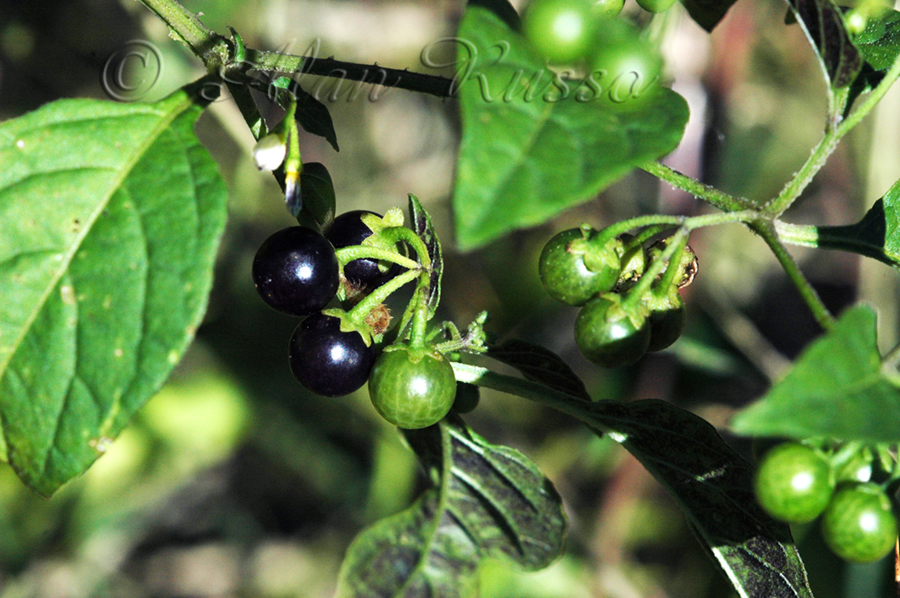
 I don't always get a chance to keep my gardens "weed" free and as it turns out this Wonderberry plant, being a Nightshade, resembles other Nightshades that you don't want to eat. So I steered clear of it for sometime, not even realizing it was the plant that I planted. Being busy I didn't get a chance to spend as much time with the plant as I would have liked so I really couldn't get a feeling for it. Finally toward the end of the season, about this same time that year, the fruits began to turn a dark blue/black that I notice that the fruits were different than any Nightshade I had seen before. There were also tiny white and yellow typical Nightshade shaped flowers on the plant that I had never seen before. Just going by gut feeling, I decided to try a couple of the ripe berries to see if I would die or get sick, luckily neither one happened! (by the way I don't recommend testing Wild Edibles this way) Well since I didn't die, I decided to spend some time learning about this new plant to see if I was right. Turns out it was the Wonderberry after all.
  Well, I now have Wonderberry growing all over, in almost all of my gardens and around my Chicken coops etc. A prolific plant to say the least. Some photos below will show you the Wonderberry I have growing. These are only meant to give a basic familiarization of the plant. Remember there are alot of toxic and poisonous Nightshades out there and many of them look very similar to one another so be careful and be 100% sure of your ID before trying any of them. Even with some edible Nightshades, like this one, the edible fruits are toxic when they are not ripe. The photos show the difference between ripe and unripe berries, don't eat the green berries!
Peace

Flowers and Green Berries

Green and Ripe Berries

Ripe and Safe to Eat
  One of the distinguishing characteristics of this plant is that 
the leaf extends all the way down the 
petiole, on both sides, to the stem.

Monday, August 13, 2012

A Possibly Disappointing Realization

  99% of what I write on this blog refers to wild plants and traditional uses of mostly cultures other than my own. Though, since I have incorporated these traditions into my own life , I guess you can call them part of my culture too.
  I am an avid vegetable gardener and maybe this endeavor never occurred to me to be an Ethnobotanical Pursuit, but as I think about it more and more, it IS about plants and it is part of MY culture and the culture of many here in the US and all over the world. So from time to time I will be adding gardening plant info/thoughts here also.
  I have 7 gardens. This year I have 100 tomato plants. I mostly grow things in my garden that most people don't, though I also grow things that many people do. What I mean is, yes I grow Tomatoes, but mostly varieties that most gardeners don't. Yes, I grow Cucumbers etc., but I add varieties that most people have never seen before. This keeps things interesting. When I hand someone a yellow Tomato or a white Eggplant or a small round yellow Cucumber, the inevitable response is; "this is a______(fill in the blank) I have never seen one like this before".
  Anyway, you may ask why a person needs 100 Tomato plants. The answer is, I like to make my own Tomato Sauce and Tomato Juice to preserve for the rest of the year. And who can get enough fresh Tomato sandwiches or fresh Tomato salad right from the garden? The growing season is relatively short, especially this year with all the rain and damp humid conditions. Good thing I planted so many plants, as much as 50% of my tomatoes are molding and rotting on the vine even before they get ripe.
  While processing and canning Tomato sauce one day I really started to look at the whole process in a very critical way and since the process takes a long time from vine to canning jar, I had plenty of time to think. One of the reasons I do all this is to save money, to be more self reliant and Environmentally friendly and to always have a supply of Organic food available. But the more I thought about it, the more I realized this may be going against that whole premise (except the part about having the food available).
  When I was an Environmental Educator, I used to teach a Primitive Technologies program. I would always refer to something I would call Appropriate Technology, which in a nutshell, is using the most primitive Technology you can for the situation at hand. This saves energy, pollution, destruction of the Environment and helps to keep us healthy through physical exercise among other things. For instance,  to dig a root out of the ground for dinner, I could use a stick to dig it out or I could build a backhoe to get it out, both would accomplish  the task equally well. But which one is appropriate for the situation?
  It was along these lines I criticized the whole Tomato canning process. So, lets go through the process from start to finish to see if I am accomplishing my goals. First, I had to get the ground ready. To do this I bought a $700.00 rototiller. To build a rototiller, first, thousands of other machines, buildings and safety equipment etc. have to be built. And to build those machines and buildings millions of other machines and factories have to be built etc. You can drive yourself crazy when you start to think of what it takes to do just one thing in a technologically advanced way. All of this is just to get the ore out of the ground. Once the ore is extracted it has to be transported to other facilities with millions of other machines and buildings etc. The extracted metal needs to be transported to many other factories with all the necessary tools and machines to get molded into parts. Than the parts transported again to the factories that build the machine, than the machine has to be transported to the stores that sell them, so I can take my van and trailer, which were built in a similar way, to pick it up to till my ground. Of course there are thousands of other steps involved in this endeavor not the least of which is the exchange of money and all it takes to produce this almighty paper product, and all the energy, time, buildings, tools, equipment and pollution it took for me to make it and the hundreds of computers and banks it takes for me to bring it home. I haven't even taken into consideration the electricity and what it take to produce it and transport it to all these factories or what it take to build the roads etc. that allows this all to happen.
 The rototiller runs on Gasoline. As do all the transport trucks and many of the machines that produce the machines. Not enough time and space to go through the whole petroleum thing from start to finish but just think of all the energy, pollution, machines, rigs, boats, storage, transport, refining, etc. it takes to get to the finished product!
 Ok, so now I have my land tilled, I need seed. I use organic seed in my gardens which lessens impact on the Earth but still demands an enormous amount of energy to produce. When you consider all the things needed on even an Organic farm, and the energy it takes to produce all that machinery, add to the mix the gas to run them  and the electricity for all the buildings and sorting and packaging machines and the trucks and gas to deliver them, the trees needed to package them and all the machinery it takes to log, transport and process the trees etc., things get crazy real fast.
 My Tomatoes are planted and ready to harvest. I have to collect them (in a petroleum based bucket, at least it's reused from something else), than prep them and than cook them. I don't know if you have ever made Tomato sauce, before but it takes days of cooking to get it right, a serious mount of propane for sure. Do I need to go through the whole getting, storing, transporting, etc. for the propane?
 Now I need mason jars.  The materials, the factories, the stores, the transport etc., etc.!!!!!!
 After all is said and done, I have about 18 jars of sauce, and 9 jars of tomato juice.
 Now it would take a mathematician and an energy flow expert to figure this all out, but it would seem to me, the amount of time, energy, pollution it takes to produce 18 jars of sauce and 9 jars of juice is just staggering.
 Somethings to consider that are beyond my expertise:  My rototiller has done alot more than help me produce these 27 jars of stuff over the last 6 years. Obviously, all the factories, trucks, roads, gasoline, machines, pollution etc. were not produced or built just for my 27 mason jars. In the life of a factory, for instance, it may produce billions of mason jars. You would have to divide all the mason jars that were produced in the factory by the amount of energy it used to be created and run for all those years to figure how much energy it takes to make one mason jar.
 So whats my point? I'm thinking that a factory, that is built to make Tomato Sauce, over its entire lifetime, can probably make a jar of tomato sauce much cheaper and use much less energy per jar of Tomato Sauce than I can at home. Hey, I'm just sayin!
Peace

Saturday, July 14, 2012

The Tallest Mullein Plant


  I remember as a kid seeing my first Mullein plant. I was fascinated by the softness of the leaves and the unusual green color that was so different from all the other plants growing around it. Of course we had no idea of all the cool things this plant was useful for. My Father was a hunter and he told me that the leaves can be used as emergency toilet paper, that's all I knew about it.
  As I got older, and became interested in Backpacking, I heard other "lore" surrounding this cool plant. We were told the soft leaves could be used to put in your boots as a soft cushion for your aching tired feet and can be used as a cushion between your boot and a blister that was forming on you foot to help ease the friction. Of course, the toilet paper idea traveled in these circles also.
  It wasn't till I became interested in Wild plants as food , Medicine and their utilitarian uses was I able to sort out the real traditional uses from the hearsay and even now I still learn new things this plant is useful for.
  When I first moved to NC, there were no Mullein plants to be found and I wondered if they grew here at all. It wasn't till about two and a half years ago did I find my first Mullein plant growing in a neglected part of my Medicinal Herb garden! I was excited to see it and cleared the surrounding plants so it would get plenty of Sun. Now, mullein has a two year growth cycle (biennial) . The first year the plant develops a Basal Rosette of leaves and the second year a tall flower spike grows from the center. So last summer the flower spike developed and I collected about a billion seeds ( the seeds are microscopically small) to plant in other places on my property. Turns out I didn't have to collect seeds because by the end of last summer there were Mullein Rosettes growing all over the place! There were probably another billion seeds that got distributed by Mother Nature. One plant in particular started to grow in my Strawberry patch and I noticed by the end of the summer and into the Fall that the plant was getting huge. The Rosette was easily three feet across and getting bigger throughout the winter.
  As the weather started to warm up this year, the Flower Spike, covered in leaves, started to grow upwards and some side spikes started to grow also making the plant even bigger than I ever dreamed. By the time the flowers started to die back and the plant got knocked over by a 60mph micro-burst during a thunder storm, the Mullein Plant was easily eight feet tall! Now this may not be the tallest Mullein plant in the world but it was the tallest most massive one I had ever seen.
 Mullein is an incredibly useful plant and I read about new uses all the time. But, as you may have noticed, I only like to write about things on this blog that I have actually tried and used in my life. My own personal Ethnobotanical Pursuits. Mullein Flowers are famous for their use in ear oils as a soothing healing remedy, especially combined with Garlic for ear infections. I have used this combo on occasion and have recommended it to others many times with good results. The Flowers are infused in Organic Olive Oil to make the infused oil. Most of the medicines this plant makes I have not had use for yet so this is the extent of my experience with its Medicinal uses. Please research this plant further to see if any of its Medicinal qualities can help you.
 I have actually used Mullein leaves as a cushion in my boots during backpacking trips and it has fended off blisters quite well. If you are a backpacker you will know the name moleskin, Mullein is like natures moleskin and soft insoles. The lore that the leaves are good for toilet paper is true, but as one of my teachers Tom Brown says, using this Sacred Plant for toilet paper will eventually come back and bite you in the ass! You see, even as a Medicinal plant, if you abuse Mullein you will probably eventually get a negative allergic like reaction to it. Tom calls this "poetic justice" to hunters who use this most Sacred Plant for something as degrading as toilet paper!
  The flower stem can be used as a spindle in a Bow Drill apparatus (HERE), especially if tipped with a harder wood. Because the stem can be quit long it makes a great Hand Drill spindle also. Though I have tried using a Hand Drill on several occasions, I have yet to get a fire started this way.
Peace

Sunday, June 3, 2012

My First Artichokes!


 Last year I took a chance and planted some Artichokes, even though all I had read made it sound like they were a hard thing to grow. The plants grew huge and I wondered what all the fuss was about, but than died off in the hottest part of the summer. I thought they were doomed but I decided to keep them to see what would happen. As it began to get cooler, signs of life were beginning to show again but only about two thirds of the plants came back and I wondered if they just liked the cool weather. Well, they like the cool but not the cold, they all died back again and no sign of life all winter long.
 As the weather began to get warmer late in the winter, again, signs of life began to show, though the winter had taken its toll and now I was down to about half of what I started with. It's amazing how big these plants get in just a short time, and they began to get huge again.
 Just the other day I was out in the garden with a friend and I was showing her the artichoke plants and she pointed to an Artichoke and actually saw the first one before I did. I searched the plants and found a total of five so far!
 I am leaving that first and largest one on the plant because I am so curious to see what the flowers look like but I picked my first two today and I cant wait to eat them!
Peace

Follow up:  I have gotten about 12 Artichokes so far. They are on the small side and don't have much meat on the "leaves" but the hearts are delicious. Hoping that next year they will be bigger. The first and largest one that I left on the plant to flower has finished blooming and will be going to seed soon. Hoping for alot of seeds to plant more for next year. Looks like Artichokes can become my next plant obsession!

Starting to open

In full bloom


Monday, April 30, 2012

Redbud Seedpods

Redbud Seedpods
 The weather has been crazy in this part of NC lately, it was in the 80s for a while, than we had a freak frost two mornings in a row which killed about 40 of my squash plants and 18 cucumber plants. Some of the wild plants were also taken by surprise and got "burned" by the frost, definitely been a crazy weather year this year.
  Still plenty of Wild Edibles to play with though, and one of the plants that just keeps on giving is the Redbud tree. Now that the Edible flowers have been pollinated and have fallen off the trees, the fruits of their labor are beginning to show. The seedpods are Edible when they are young and succulent. If you wait too long they will get tough and stringy and are no fun to eat. If you take one of the young pods and bend it in half it should "snap" apart. If you wait too long they will stay together because they are stringy. The raw seedpods, right from the tree, have a somewhat tangy taste. A good snack food or addition to a salad or stir fry. Remove the stem before eating or use it as I do to hold my snack while eating. I eat a hand full once and that sour taste turned astringent and was not as pleasurable as eating just a few as a snack. I have never eaten a large quantity of the pods so proceed with caution and see if they agree with you first, remember you can be allergic to a wild plant as easily as a "common" food plant.
 Don't forget to look closely at the pods so you get to know them before you eat and of course make sure they are REDBUD pods by ID-ing the tree first if you didn't see it in bloom. If you enlarge the photo above you will notice a "fishhook" at the bottom of the pod
  I think its fun to just walk over to the Redbud Tree on the way to the garden and in the early Spring snack on the Flowers than later on snack on the young pods. Nature is so COOL!
Peace